Printing Black America: Du Bois's Data Portraits in the 21st Century
William Villalongo and Shraddha Ramani
EMPLOYMENT

William Villalongo and Shraddha Ramani, Occupations of Black Americans 1900 - 2021, 2025. Screenprint, chine collé. 28 x 22 in. Printed and published by Island Press, Washington University, St. Louis, MO. © Villalongo Studio LLC. Courtesy William Villalongo, Shraddha Ramani and Island Press, St Louis, MO.
OCCUPATIONS OF BLACK AMERICANS, 1900-2021
The image shows the changing face of Black participation in various occupations since Du Bois's original work in 1900 until today. The timeline runs from 1900 at the bottom to 2021 at the top. The colorful plumes fluctuate between thick and thin as Black participation in each of the eleven categories shifts. This image updates two original Du Bois data portraits which show occupation categories and Black participation nationally and in the state of Georgia. The image is a simple bar chart that has been manipulated to smooth out the jagged zigzag of straight lines into curves, suggesting colorful flows through time.

William Villalongo and Shraddha Ramani, Average Annual Income and Expenditures of Black Families in the U.S., 2025. Screenprint, chine collé. 22 x 28. Printed and published by Island Press, Washington University, St. Louis, MO. © Villalongo Studio LLC. Courtesy William Villalongo, Shraddha Ramani and Island Press, St. Louis, MO.
AVERAGE ANNUAL INCOME AND EXPENDITURES OF BLACK FAMILIES IN THE U.S.
This infographic is an update of one of Du Bois's most iconic data portraits, which was illuminated by beautiful photographs of Black families and a gold "one dollar" coin. We decided to take a national average given that the data exists now. Without this data, Du Bois focused on Georgia using surveys taken door-to-door. As we look at the 21st century, how Black families divide their income has changed along familiar lines. We see that housing is taking up the greater portion of their income and there is an increased investment in what Du Bois termed "the higher life," things such as savings, education and healthcare. As the plastic shopping bag comes to an end in many towns, we celebrate the gold and black ones. A sign of financial means in many places, the humble plastic bag is an iconic part of history, deserving its rightful place as Pop Art.
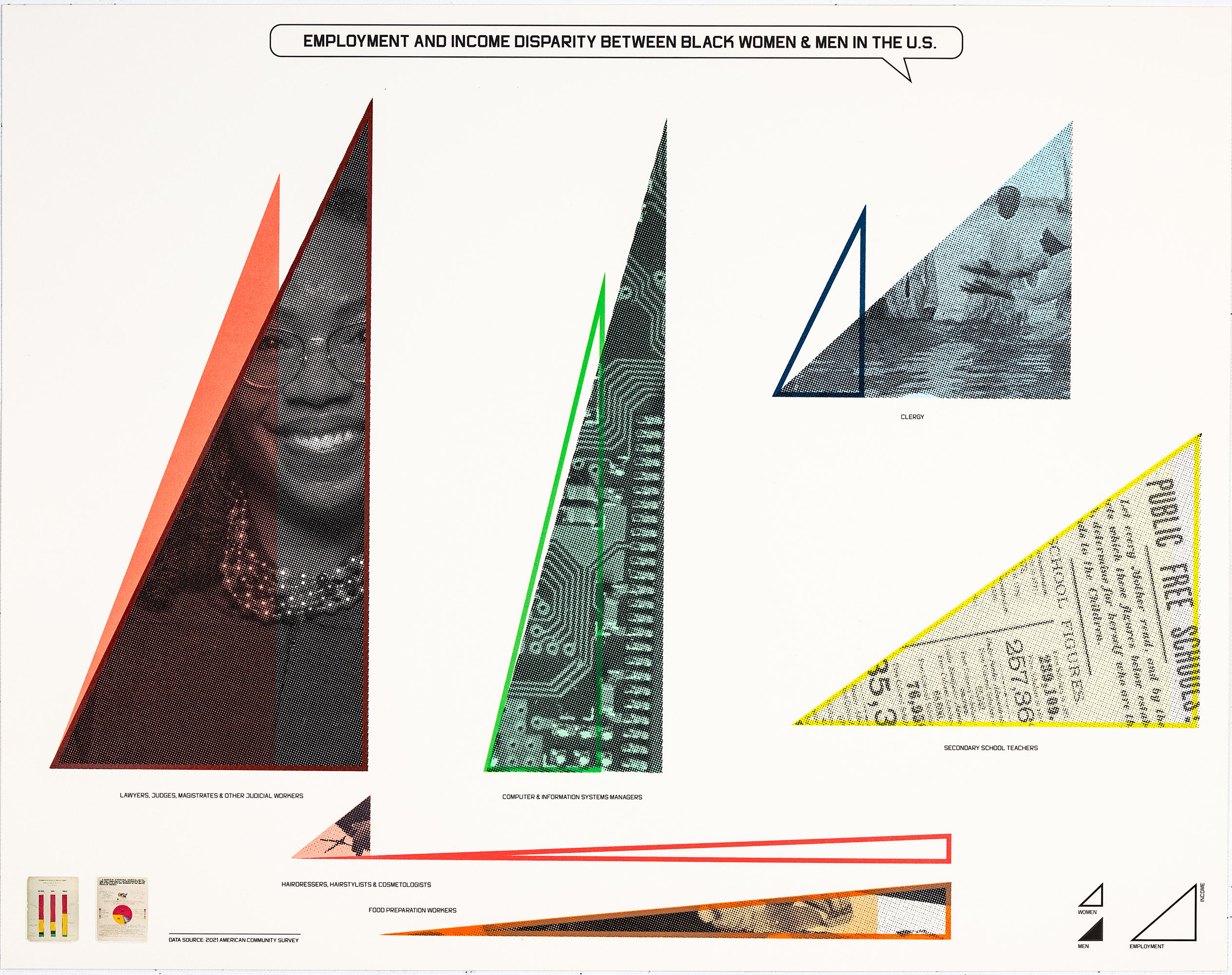
William Villalongo and Shraddha Ramani, Employment and Income Disparity Between Black Women and Men in the U.S., 2025. Screenprint, chine collé. 22 x 28 inches. Printed and published by Island Press, Washington University, St. Louis, MO. © Villalongo Studio LLC. Courtesy William Villalongo, Shraddha Ramani and Island Press, St. Louis, MO.
EMPLOYMENT AND INCOME DISPARITY BETWEEN BLACK WOMEN AND MEN IN THE U.S.
The image shows the income to employment disparities in six professional fields. Since 1900, there have been considerable strides in Black employment, particularly in the expansion of possibilities for employment. However small in number, Black people are working across the spectrum of occupations. Even so, it is no surprise that Black unemployment remains relatively high compared to that of other races. Here we decided to focus on Black men and women for a more intimate story in the larger employment story using a series of triangles. The length of each base represents employment while the height of the triangles represents income. Women are represented by a colorful outline, and men are represented by a colored fill. The photographic images do not represent data, they illustrate each occupational category. When we compare these disparities between Black men and women, we see interesting trends where one gender may outpace the other within a given field. Some of these are surprising, such as the relatively small amount of men hairstylists, who compared to women make almost double the income, or how women outpace men in income and employment in the field of lawyers, judges, magistrates and other judicial workers.

William Villalongo and Shraddha Ramani, Reclaimed Family Tree: Ancestors Enslaved by Jesuits at St. Louis University and Region 1823-1865, 2025. Etching, aquatint, chine collé. 28 x 22 in. Printed and published by Island Press, Washington University, St. Louis, MO. © Villalongo Studio LLC. Courtesy William Villalongo, Shraddha Ramani and Island Press, St. Louis, MO.
RECLAIMED FAMILY TREE: ANCESTORS ENSLAVED BY JESUITS AT ST. LOUIS UNIVERSITY AND REGION 1823-1865
In 2019, Robin Proudie and members of her family were contacted by researchers from the Slavery, History, Memory, and Reconciliation Project (SHMR)—a joint initiative between Saint Louis University and the Society of Jesus—to study their ties to slavery. The research revealed that SLU enslaved upwards of 70 people between 1823-1865, many of whom were Robin's ancestors. In response, Robin led other descendants and a group of allies to form Descendants of the St. Louis University Enslaved, or DSLUE, an organization centered around Remembrance, Restoration, and Repair. Through the SHMR project, Robin was able to make a simple family tree going back roughly four generations under the categories "Enslaved by the Jesuits/SLU", "Enslaved by Another" and "After Emancipation". We portray her reclaimed family tree as a cross section of a literal tree as viewed from above. The trunk holds the original enslaved people from Maryland, sold to the Jesuits at SLU. The branches spur out and around with each consecutive generation.

William Villalongo and Shraddha Ramani, "Sites of Wounding/Sites of Healing" Alternative Atlas: STL, 2025. Screenprint. 28 x 22 in. Printed and published by Island Press, Washington University, St. Louis, MO. © Villalongo Studio LLC. Courtesy William Villalongo, Shraddha Ramani and Island Press, St. Louis, MO.
"SITES OF WOUNDING/SITES OF HEALING" ALTERNATIVE ATLAS: STL
We learned many things from scholars in STL and WashU, but the most amplified was the incredible impact that Walter Johnson’s book The Broken Heart of America: St. Louis and the Violent History of the United States has had on how the city sees itself in various spheres, from academia and cultural institutions to current political arguments. Johnson’s book arcs the founding, flourishing and decline of St. Louis as an industrial center of America. It reaches deeply into the geography of the city accounting atrocities and triumphs neighborhood by neighborhood and block to block. It explains how the ghosts of the past live in present STL making what was once a major destination for Black people during the Great Migration one of the most inhospitable places for Black people to exist in the U.S.
Walter Johnson at Harvard and Linda Samuels and Geoff Ward at WashU developed a cross disciplinary studio course called "Alternative Atlas: STL" for WashU in which students mapped the sites in Johnson's book, connecting the current geography and architecture of the city to layers of the past. They labeled them as "sites of wounding" or "sites of healing," and later this data would be pulled into an interactive map which animates points, areas and streets on which these occurrences accumulate over time and space. We present their map as a still image which has all the layers present. Through the process of printmaking, we recreate a dissipation effect of layers through translucency along the map’s timeline of events. We stayed true to their original color scheme, which gives one the feeling of hovering over a city at night. While not every data point in "The Broken Heart of America" is connected to Black histories, their stories and the stories of others have impacted the present Black population of STL most acutely. Instead of listing every location, our work encourages the viewer to see the city as a complex of emotions and a place to discover Johnson's book or the Alternative Atlas project.
Previous Portfolio
Next Portfolio
Printing Black America Home
William Villalongo
William Villalongo was born in 1975. He lives and works in Brooklyn, NY. He received his BFA from The Cooper Union School of Art, MFA from Tyler School of Art at Temple University and attended Skowhegan School of Painting & Sculpture. His figurative paintings, works on paper and sculpture are concerned with representing the Black subject against notions of race and exploring metaphors of mythology and liberation. His curatorial projects – American Beauty at Susan Inglett Gallery in 2013 and Black Pulp! touring nationally between 2016-2018 – explore the intersections of politics, history and art. Villalongo is the recipient of the prestigious Louis Comfort Tiffany Award and the Joan Mitchell Foundation Painters & Sculptor's Grant, and was the 2022 Jules Guerin & Harold M. English Rome Prize Fellow in Visual Art. His work is included in several notable collections including the Studio Museum in Harlem, The Whitney Museum of American Art and Princeton University Art Museum and El Museo del Barrio. His work has been reviewed in Art in America, The New Yorker and the New York Times. The artist is represented by Susan Inglett Gallery, New York and is an Associate Professor at The Cooper Union School of Art.
Shraddha Ramani
Shraddha Ramani is an urbanist and researcher based in Brooklyn, NY. She uses data visualization and mapmaking as tools to make cities more resilient and equitable. Her work is centered around democratizing data to better equip communities to make informed decisions about their futures. She worked in multiple capacities in the Geographic Information Systems (GIS) department at New York City Emergency Management, finishing as the Director of the GIS Data Center. In this role she directed a team to make data-driven decisions for emergency planning, response, recovery, and mitigation. In earlier roles she developed online applications to help the public visualize and understand natural hazard risks in their communities. Previously, she worked on the development of the Future City Lab exhibition at the Museum of the City of New York. Shraddha Ramani is from Bangalore, India and her work is heavily informed by her own immigrant experience. She has participated in planning projects in India and Brazil and was a Peace Corps volunteer in Ecuador. She has a Master's degree in Urban Planning from Columbia University, and a BA in Environmental Studies from Oberlin College.
Further Resources
William Villalongo's Website: villalongostudio.com
Printmaking + Sculpture Terms
Sales
For sales, or more information about an edition, please contact Graphicstudio at (813) 974-3503 or gsoffice@usf.edu.
Copyright + Reproduction
Images of the artwork are jointly owned by the artist and Graphicstudio. Reproduction of any kind including electronic media must be expressly approved by Graphicstudio.