Things Don't Seem The Same:
2026 MFA Thesis Exhibition
April 3 - May 9, 2026
USF Contemporary Art Museum
Admission: Exhibition and events are free and open to all.
Normal Hours: Mon, Tue, Wed, Fri 10am-5pm; Thu 10am-8pm; Sat 1-4pm; Closed Sundays

Diana Sosnowska, Gravity, 2025. Image courtesy of the artist.
This eagerly awaited annual exhibition features thesis projects in a variety of media by 3rd year Master of Fine Arts students from the USF School of Art & Art History. The 2026 artists are: Enoch Appiah, Mike Cannata, Patrick Michael Carew, Darlene Gold, Atia Shafie, Diana Sosnowska, and Brogan Willis.
EXHIBITION CATALOGUE
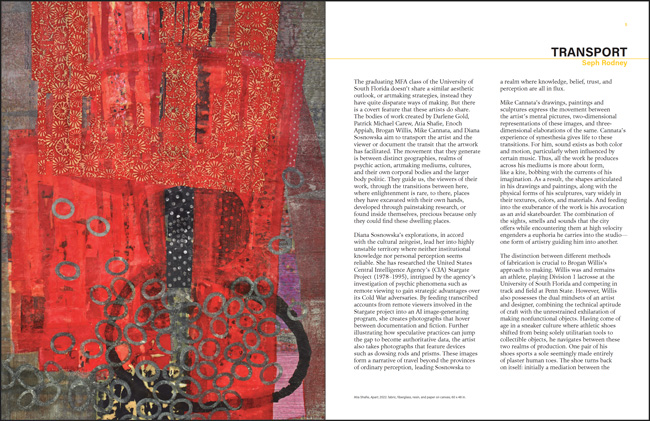
View and download a pdf of the Things Don’t Seem The Same: 2026 MFA Thesis Exhibition catalogue. The 58-page full color publication is available to students and museum visitors without cost, and includes an essay and MFA artist profiles by Seph Rodney, and texts by USFCAM Acting Director Dr. Kristina Keogh, and USF School of Art & Art History Director Andrew Scott Ross.
EXHIBITION CHECKLIST
View the Things Don’t Seem The Same: 2026 MFA Thesis Exhibition exhibition checklist pdf.
ABOUT THE ARTISTS
Enoch Appiah

photo: Forrest MacDonald
Enoch Appiah is a Ghanaian artist with a focus in ceramics and mixed media. He earned his undergraduate degree in Ceramics from Kwame Nkrumah University of Science and Technology (KNUST) in Ghana. His practice is rooted in a hybrid approach that brings together ceramics and repurposed materials such as cardboard, wire, and plastic waste. By combining traditional hand-building and wheel-thrown clay techniques with discarded industrial materials, Appiah creates sculptural forms that explore the intersections of culture, identity, environment, and systems of consumption.
His interest in working with found and recycled materials stems from a personal and cultural connection to resourcefulness and adaptation, a common practice in many Ghanaian communities. Plastic containers, packaging, and wire, often regarded as waste in the West are integrated into his work to highlight the contrast between the organic and the synthetic, the ancient and the contemporary. These materials are not merely aesthetic choices but carry embedded histories of use, labor, and place.
Appiah’s sculptures and installations often reflect a quiet but intentional commentary on sustainability, collective memory, and transformation. He views the studio as a site of repair and reinvention, where overlooked materials are reshaped into new narratives.
Mike Cannata

photo: Forrest MacDonald
Mike Cannata (b. 1996) from Chicago, IL is a multimedia artist who works in large-scale painting, sculpture, installation, and ceramics. He has been working primarily in ceramics over the past 10 years, creating larger-than-life sculptures and utilizing oozing and expanding glaze concoctions. Cannata creates narrative through his gestural and emotive paintings and sculptures.
Cannata received a Bachelor of Fine Arts from The New York State College of Ceramics at Alfred University (Alfred, NY). From 2021 to 2023, Cannata took part in a long-term residency program at the Morean Center for Clay (St. Petersburg, FL). In 2020, Cannata participated in two residency programs at Guldagergaard International Ceramic Research Center (Skaelskor, Denmark). His artwork has been exhibited throughout the U.S. and internationally in Denmark, Russia, South Korea, and Romania. Cantata’s work has been shown in numerous group and solo exhibitions, including in the U.S. Capitol Building (Washington DC), The Chihuly Collection (St. Petersburg, FL), and the Museum of Nonconformist Art (St. Petersburg, Russia). This winter, he exhibited at the Satellite Art Show (Miami, FL) during Miami Art Week. In the coming months, he will participate in Pathways, an exhibition at the Rollins Museum of Art (Winter Park, FL) and the University of Central Florida Art Gallery (Orlando, FL).
Patrick Michael Carew

photo: Forrest MacDonald
Patrick Michael Carew (b. 1996, Utica, NY) is an image-based artist working at the intersection of photography and printmaking. His practice integrates darkroom techniques, digital imaging, and traditional print processes to explore the body and the image as a means of preserving queer identity while reflecting on shared narratives within history and community. Working with his own blood, archival queer photographs, and layered collage, Carew examines how the body functions as both matrix and record, navigating the politics of exposure, touch, and survival within the ongoing reverberations of the HIV/AIDS crisis.
Carew’s work has been exhibited at INK Miami Art Fair (Miami, FL), Tempus Projects (Tampa, FL), REVERB Gallery (Tampa, FL), The Munson Museum (Utica, NY), and Pratt Manhattan Gallery (New York, NY), with features in publications such as Upstreams Deadfalls (Deadfall Press), PRIMAL SIGHT (Gnomic Books), Queer Anthology of Wildness (Pilot Press), and MATTE Magazine (MATTE Editions). Beyond his studio practice, Carew teaches at the University of South Florida and has previously worked as a studio technician at Pratt Munson and holds a BFA in Photography from Pratt Institute.
Artist's website: www.patrickmcarew.com
Darlene Gold

photo: Forrest MacDonald
Through self-portraiture that foregrounds pleasure, vulnerability, and connection, Darlene Gold’s photography challenges cultural assumptions about age, sexuality, and female visibility. Her self-portraits position the aging female body as an active subject of desire. She extends this inquiry through performance and image-text works that explore erotic self-disclosure as both risk and agency.
Her work has been recognized in juried exhibitions including the Carolyn M. Wilson Gallery: 48th & 46th Annual Juried Student Art Exhibitions; Image City’s Magic of Light Exhibition, Rochester NY; State of the Art Gallery’s 32nd & 31st Juried Photography Exhibitions, Ithaca NY; and Schweinfurth Art Center’s Made In New York (MINY) Auburn, NY. Gold’s photography awards include: Judge’s Pick at State of the Art Gallery’s 32nd Juried Photography Exhibition; “Top Honor Prize,” WSKG’s TV Portraits and Dreams 2021 Photography Challenge. Video and photography-text performance pieces include: Night Reading for Foxes, featured in the award-winning documentary: Liminal Worlds, and Never Before Has a Window Seemed So Much Like an Ear: for Gary Sczerbaniewicz’s Tower and the Shard, performed at SUNY Dowd Gallery, Cortland NY.
After a career as a college professor and creative writer in New York, Gold (b. 1964) left her tenured position to pursue studio art at the University of South Florida, deepening her commitment to image-based practice. Gold holds degrees in English and Creative Writing (BA, Boston University; MFA, Columbia University; PhD, Binghamton University), which inform her interdisciplinary approach to image and text.
Atia Shafie

photo: Forrest MacDonald
Born in Oklahoma in 1984 and raised across Texas and the American South, Atia Shafie’s childhood shifted dramatically in the mid-1990s when, at the age of ten, she migrated with her family to Iran. The decade she spent there—negotiating new cultural codes while holding onto the remnants of another life—became the foundation of her artistic sensibility. Returning to the United States in 2005, she rebuilt her life independently. She pursued art studies, moving from graphic design to painting before ultimately finding her voice in sculpture and completing her BFA in Los Angeles, CA.
Working through painting, collage, and layered material processes, Shafie treats her gathered fragments as active participants—both witnesses and storytellers. The paper scraps, fabric remnants, dirt, resin, and domestic fragments she collects spark a dialogue with the objects and symbols in which people place faith—personal, cultural, and collective. Her compositions form a tangible, physical cacophony, reflecting the layered tensions between the individual and society, and between memory and myth.
Rooted in the complexities of migration and hybrid identity, her practice operates as an archaeology of personal and cultural history. Through cycles of accumulation and erasure, she constructs dense, stratified surfaces that emulate the fragile, shifting nature of recollection. In merging painterly sensibilities with sculptural materiality, Shafie maps the emotional terrain of living between languages, geographies, and histories—creating works that ask viewers to look closely, dig deeper, and confront the many-layered realities that shape who we become.
Artist's website: themarkaz.org/author/atiashafee/
Diana Sosnowska

photo: Forrest MacDonald
Diana Sosnowska (b. 1995) is a Polish-Italian visual artist working between Florida and Italy. She holds a BA in Photography from Robert Gordon University, Scotland.
Her practice investigates how institutional regimes and scientific knowledge systems both record and construct knowledge. Through the manipulation of institutional, governmental, and vernacular archives, staged photography, and sculptural interventions, Sosnowska challenges dominant understandings of history and memory, exploring the spaces where truth and fiction converge.
Her work has been exhibited in juried group exhibitions at The Bridge and Tunnel Gallery (New York, NY), Le Stanze della Fotografia (Venice, Italy), and Photofusion (London, UK), and in solo exhibitions at Studies in Photography (Edinburgh, UK) and the Florida Museum of Photographic Arts (Tampa, FL). She is a recipient of the British Journal of Photography’s Female in Focus Award (2022) and the SPE Student Award for Innovations in Imaging (2026).
Artist's website: www.dianasosnowskaphotography.com
Brogan Willis

photo: Forrest MacDonald
Brogan Willis, born in 2000, is a sculptor and designer from Cleveland, Ohio, and was raised in Charlotte, North Carolina. He completed his undergraduate studies at Penn State with a BFA in Sculpture. Willis’s work explores the intersection of athletic discipline, material labor, and cultural memory. Approaching sculpture through a process-driven lens, he tests how ordinary objects, particularly sneakers, can be transformed through repetition, endurance, and physical constraint. His practice reframes the “unnecessary,” reimagining footwear as vessels of identity, labor, and personal history.
Rooted in years of competitive athletics, Willis channels the same rigor, persistence, and physical demand found in sport and sculpture. This embodied approach shapes his relationship to materials, pushing them beyond expected limits to reveal new structural and conceptual possibilities. His sculptures merge craft and critique, functioning simultaneously as artifacts of memory and examinations of value, function, and cultural symbolism.
Things Don't Seem The Same is presented with the support of the USF College of Design, Art & Performance, the USF School of Art & Art History, The Stanton Storer Embrace the Arts Foundation, the Allen W. and Janet G. Root CAM Endowment, and the Lee and Victor Leavengood Contemporary Art Museum Endowment.
